Context
Publishing consistently on LinkedIn takes time: you need to reframe an article from multiple angles, test different hooks, vary the formats. For a freelancer, that’s time taken away from client work.
To explore this use case and demonstrate how AI fits into an automated workflow, I built a pipeline that takes an article title and summary as input, and sends back three distinct LinkedIn posts by email, ready to edit.
The workflow
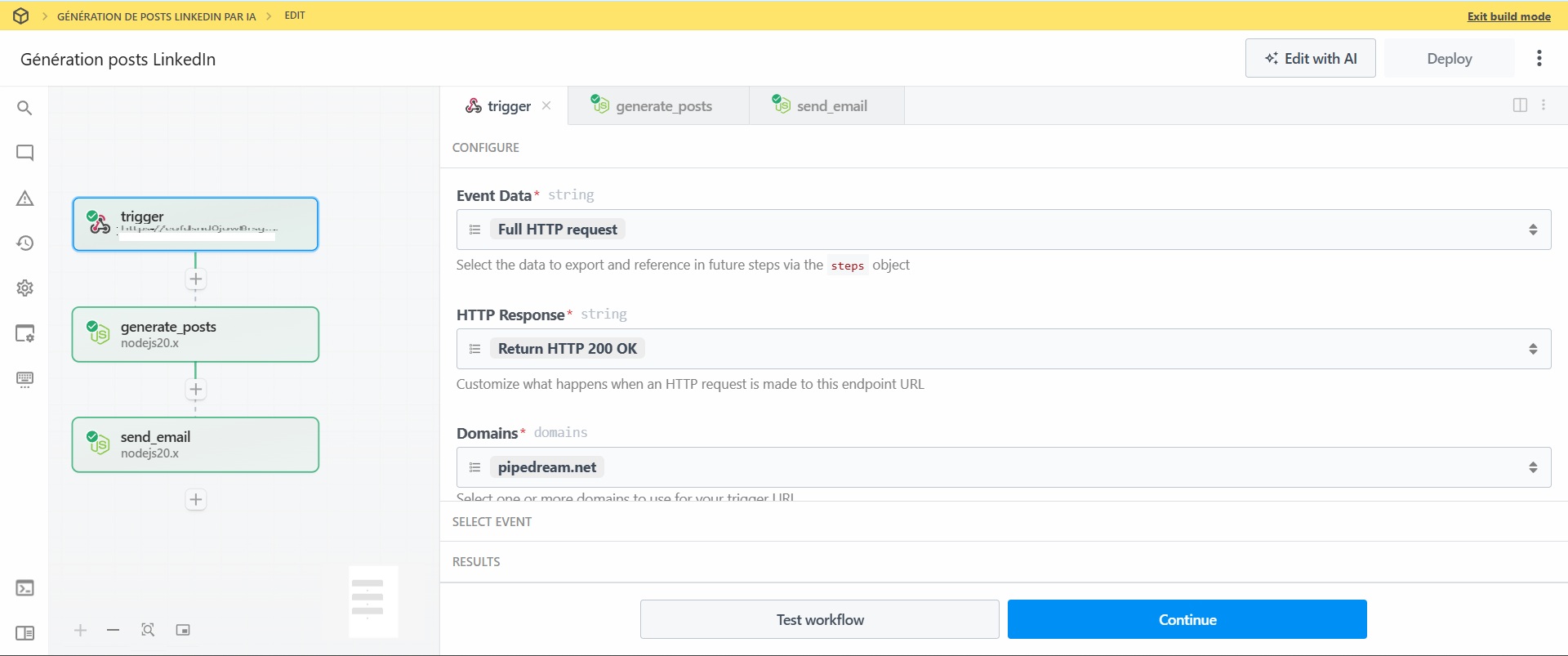
What the workflow does
As soon as an HTTP request hits the webhook, Pipedream automatically runs:
- Reception (
receive_article): the webhook receives a JSON payload withtitre,urlandresume - AI generation (
generate_posts): calls the Groq API with an LLM — the prompt requests three distinct posts: informative, storytelling and an engaging question - Email delivery (
send_email): the three posts are sent by email, ready to copy and refine
The tools
- Pipedream — serverless automation platform, free plan (100 credits/month)
- Groq — ultra-fast open-source LLM inference, free plan (14,400 requests/day)
- Node.js — both processing steps are written in JavaScript inside Pipedream’s editor
- HTTP Webhook — simple trigger, callable from any script or tool
Technical choices
Why Groq and not Gemini or OpenAI? Groq uses a dedicated hardware architecture (LPU) that makes inference extremely fast — under one second to generate 600 words. The free plan is generous (14,400 requests/day) and requires no credit card.
Why three post styles? The goal isn’t to publish the raw output, but to have three different angles to choose from or combine. The informative style works for technical tips, storytelling for personal experience, and the question format for community engagement.
Why Pipedream and not Make? Make already handles this site’s contact form. Pipedream lets you write Node.js directly inside each step — useful for calling APIs with no native integration. Both tools are complementary: Make for no-code workflows, Pipedream when steps require custom code.
Note: Pipedream is shutting down its workflow offering on March 31, 2027. This workflow was built as a technical demonstration — for production use, it would be migrated to n8n or a hosted script.
What the project demonstrates
- Integrating an LLM into an automated pipeline (API call, prompt engineering, response parsing)
- Proficiency with Pipedream and its serverless Node.js model
- Prompt engineering: structuring a prompt to get three distinct formats in a single API call
- Tool complementarity: Make, Pipedream and n8n each cover different needs